
Video content reigns supreme across the modern digital landscape. Whether you are a digital marketer, an online educator, a small business owner, or a social media influencer, video is undeniably the most effective medium to capture audience attention and drive meaningful engagement. However, traditional video production has always been notoriously difficult and time-consuming. Producing a polished video requires a multitude of skills: scripting, storyboarding, sourcing footage, trimming clips, syncing audio tracks, and generating accurate subtitles.
This intensive, multi-step process often creates a massive bottleneck for creators and marketing teams who need to publish high-quality content consistently. Fortunately, the rapid integration of Artificial Intelligence (AI) and Large Language Models (LLMs) is fundamentally changing the way we approach video creation.
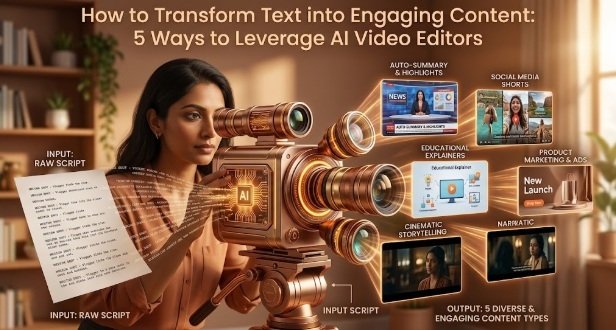
Instead of spending hours staring at a complex, overwhelming timeline, you can now generate, edit, and refine videos using simple text prompts. In this comprehensive guide, we will explore five powerful ways you can leverage AI video editors to transform your raw ideas into polished, captivating visual stories.
1. Automated Script-to-Video Workflows
The most significant hurdle in the video creation process is often the blank page. Coming up with a compelling narrative structure, a strong hook, and a clear call-to-action takes considerable time and mental energy. AI solves this initial roadblock by allowing you to generate a complete, highly structured script from a simple text prompt.
But modern innovation does not stop at text generation. Advanced tools have successfully bridged the gap between text generation and visual assembly. Instead of copying a script into a separate program and manually searching for corresponding clips, you can now use deeply integrated AI workflows.
For instance, by utilizing a ChatGPT video editor free from tedious manual setup, creators can input their raw footage alongside natural language instructions directly into a chat-based interface. The AI analyzes your instructions, evaluates the uploaded footage, and automatically generates an editable rough cut on your timeline. This seamless transition from a text concept to a visual draft eliminates hours of tedious manual setup, allowing you to focus entirely on creative refinement.
2. Context-Aware Asset Matching and B-Roll
Even if you have written a brilliant script, a video consisting entirely of a static “talking head” can quickly lose a viewer’s attention. To keep audience retention rates high, professional creators rely heavily on B-roll supplementary footage that visually reinforces what the speaker is saying.
Traditionally, finding the perfect B-roll required manually scouring expensive stock libraries for hours on end. AI video editors streamline this exhausting process by actively “reading” your script and understanding the context of your narrative. As it processes your text, the AI automatically suggests and inserts relevant stock footage, images, and visual effects that match the tone of each specific scene.
Furthermore, if you are using your own media, the AI can intelligently match your clips with high-quality design templates, ensuring that the visual pacing aligns perfectly with your story’s emotional beats and transitions.
3. Instant Rough Cuts and Dead-Air Removal
If you have ever filmed a talking-head tutorial, a vlog, or a video podcast, you know that the raw footage is rarely perfect. It is usually filled with long awkward pauses, stumbled words, throat clears, and multiple bad takes. Sifting through this raw footage to find the usable moments is an incredibly tedious part of post-production.
AI-driven editing tools are now capable of analyzing audio waveforms and visual cues to perform this “rough cut” automatically. The software can instantly detect and delete silent gaps, filler words (like “um,” “uh,” and “like”), and obvious audio mistakes.
By the time you sit down to actively edit, the AI has already condensed a messy 45-minute recording into a tight, highly watchable 15-minute sequence. This automation saves an enormous amount of mental energy and time, leaving you free to focus on adding music, color grading, and creative flair.
4. Intelligent Subtitling and Global Translation
In the age of mobile browsing, a massive portion of video content is consumed on smartphones with the sound completely turned off. If your videos do not feature accurate, dynamic captions, you are actively losing viewers who are scrolling through their feeds in public spaces.
Manually transcribing audio and keyframing text to match the speaker’s exact cadence is exhausting work. Modern AI video editors feature powerful speech-to-text algorithms that generate perfectly synced subtitles in a matter of seconds.
Furthermore, these tools allow you to stylize the text with engaging animations, bold colors, and custom fonts that highlight keywords to retain viewer attention. Beyond basic transcription, advanced AI tools can translate your spoken audio and generate subtitles in dozens of different languages, allowing you to seamlessly repurpose your content for a global audience without hiring expensive translation services.
5. Frictionless Multi-Platform Repurposing
Creating a single, high-quality video is only half the battle; distributing it effectively across different social media platforms is where real audience growth happens. However, a horizontal 16:9 video meant for YouTube or a corporate website does not perform well on vertical-first platforms like TikTok, Instagram Reels, or YouTube Shorts.
Manually reframing every single scene to fit a vertical aspect ratio is a time-consuming chore that requires constantly shifting the video frame to keep the subject in view. AI editing tools solve this by offering smart auto-reframing capabilities.
The AI automatically identifies the primary subject in your video (such as a person’s face, a moving car, or a product) and keeps it perfectly centered as it crops the video into a 9:16 format. This allows creators to shoot their content once and instantly generate optimized, perfectly framed versions for every major social media channel in just a few clicks.
Frequently Asked Questions
What exactly is a prompt-based AI video editor?
A prompt-based AI video editor is an advanced software tool that uses natural language processing (similar to AI chatbots) to assist in video creation. By typing a plain-text description of what you want (e.g., “Create a fast-paced travel vlog using my uploaded beach clips”), the AI analyzes your text and automatically structures a rough cut, selects relevant templates, and applies edits based directly on your written instructions.
Can AI video editors completely replace human video editors?
No, AI is not a complete replacement for human creativity, emotion, and judgment. While AI excels at automating tedious administrative tasks like transcription, removing silent pauses, auto-reframing, and organizing rough cuts the human editor is still absolutely essential for dictating the creative direction, injecting personality, and refining the final narrative structure of the video.
Do I need advanced technical skills to use ChatGPT-integrated video tools?
Not at all. The primary advantage of these next-generation AI tools is their accessibility. Because they operate on natural language prompts, you do not need to understand complex editing timelines, keyframe animations, or color grading interfaces to generate a high-quality video draft. If you can type a descriptive sentence, you can use these tools to build a video.
How does AI help with video accessibility for diverse audiences?
AI drastically improves video accessibility by automatically generating highly accurate closed captions and subtitles in real time. This ensures that your content can be understood by viewers who are deaf or hard of hearing. Additionally, AI translation features allow you to instantly generate subtitles in multiple foreign languages, breaking down language barriers and making your content accessible to a truly global audience.
Conclusion
The technical barrier to entry for high-quality video production has never been lower. By embracing the power of artificial intelligence and natural language processing, modern creators can bypass the most frustrating, time-consuming aspects of post-production.
Whether it is generating an initial script, automatically matching context-aware B-roll, cutting out dead air, or resizing formats for global social media distribution, AI acts as a tireless digital assistant that dramatically scales your creative output. The future of digital content creation belongs to those who learn to collaborate effectively with these tools, merging human creativity with incredible machine efficiency to tell better, more engaging stories.
